Author
Viljar Vald, CIO
Date
06/05/2026
In April 2026, the equity markets entered a state of exception. The broad market indices like the MSCI World and S&P 500 posted eye-watering 10% returns in a single month. But beneath the surface, things get even more interesting. The Philadelphia Semiconductor Index (SOX) posted a +38% monthly return – a rate of increase seen only once before, during the terminal "blow-off top" of February 2000. Simultaneously, an index of unprofitable technology companies rallied +25%.
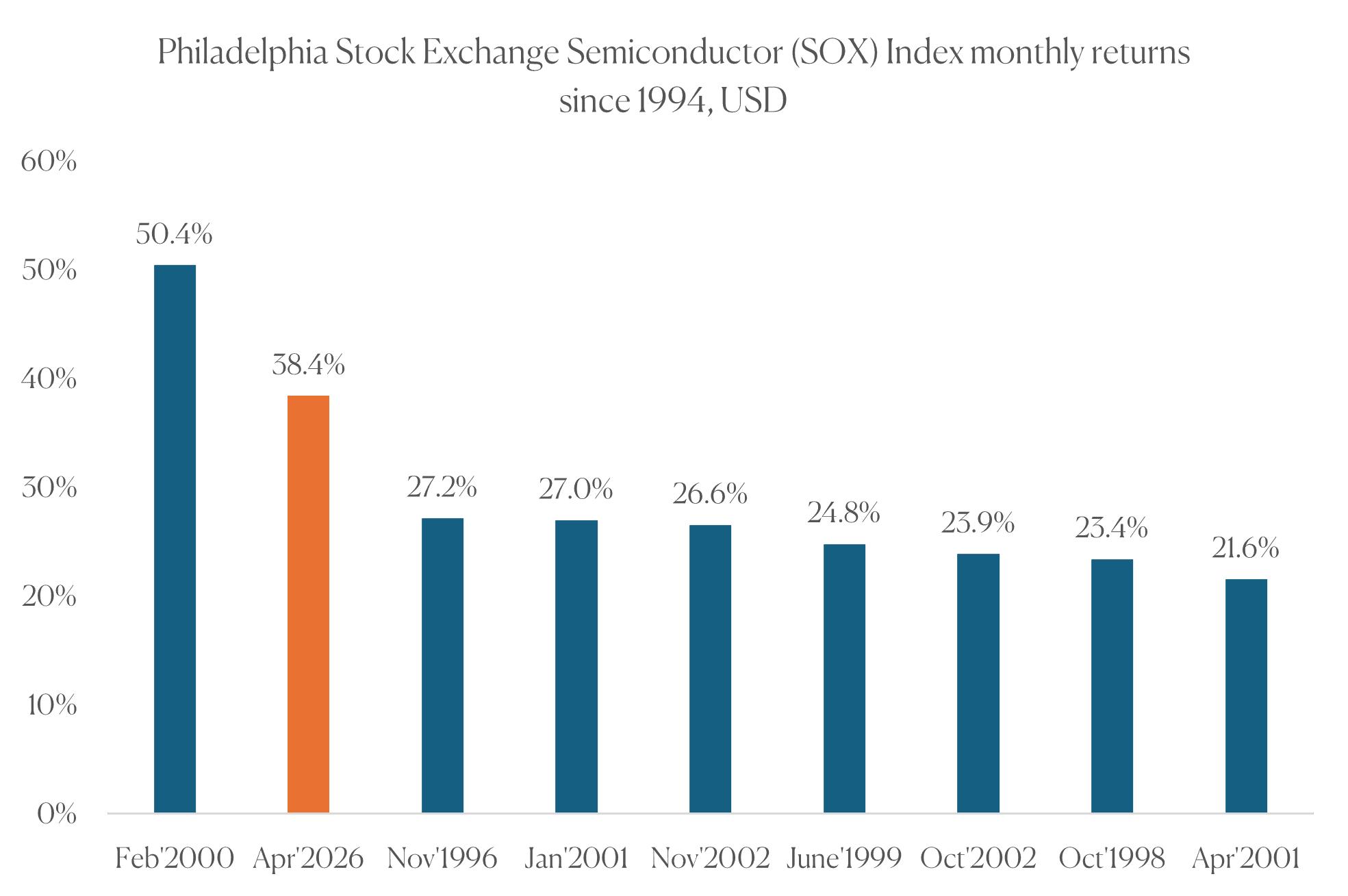
To the casual observer, this can look like the dawn of a new era. To a student of history, it feels like a familiar fever—one that creates a profound tension: maintaining a proven system, or giving in to the fear of being left behind by a statistical anomaly. To understand the strategic choice facing a disciplined allocator in this environment, it helps to look away from the terminal and toward the basketball court.
The Logo Shot
Imagine a basketball coach who has spent a career perfecting a system based on disciplined defense and high-probability shots. In the first quarter of a major game, the opposing team hits three consecutive shots from the half-court logo. The crowd is on its feet, and the momentum feels unstoppable.
Does that coach abandon his playbook? Does he tell his players to start hucking the ball from the logo because "the game has changed"?
Probably not. He recognizes that a half-court shot, while spectacular, is a statistical outlier or a "Junk Shot". Relying on it might win a quarter, but the laws of probability suggest it rarely wins the championship. April 2026 was the market hucking half-court shots.
Why is the market so mesmerized by these "junk shots"? Behavioral finance points to investor lottery preferences. Humans are naturally attracted to positive skewness, the "lottery ticket" payoff. People have a well-documented tendency to overpay for a slim chance of a massive gain, even when the expected value is negative. And the stock market is no exception. In a "lottery phase", the focus shifts from calculating risk to chasing the jackpot.
The Ghost of Dot-Com
When a major index like the SOX moves 38% in twenty business days, we must look at the math. In February 2000, the narrative was identical to today: „Traditional metrics are relics. This time is different.“ Yet, the market inevitably returns to the only metric that remains undefeated: the present value of future cash flows.
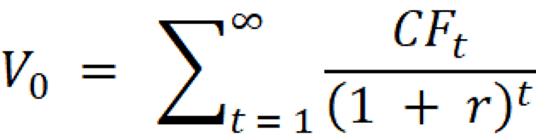
If the cash flow remains a future promise rather than a current reality, the investment relies on the "Greater Fool" theory. That is a strategy based on sentiment, not on the physics of capital.
The Innovation Paradox: Society Wins, Investors Lose
History is littered with the wreckage of "game-changing" technologies that transformed the world but incinerated capital.
· Railroads (19th Century): The rail network laid the foundation for the modern economy. Yet, of the hundreds of companies that laid the tracks, the vast majority went bankrupt. Society got the infrastructure; investors got the bill.
· Automobiles (Early 20th Century): In the early 1900s, there were over 2,000 car manufacturers in the US. By the end of the century, only three remained. The car changed the world, but most who bet on the early pioneers lost everything.
· Airlines: Perhaps the greatest gift to global connectivity, yet as Warren Buffett famously noted, the airline industry as a whole made nearly zero aggregate profit for the first century of its existence.
· The Dotcom Era: In 1999, the "Information Superhighway" was real. The expectations were correct – the internet did change everything. But the "winners" of 1999 weren't the winners of 2010. Billions were lost on companies that had the right vision but the wrong math.
In every instance, the technology dissolved into the fabric of society. It became a utility. The winners were often not the first movers, but rather the efficient consolidators who arrived after the speculative fire had burned itself out.
The Rationalist’s Exhaustion
There is a specific kind of pain reserved for the rational investor during these runs. It is the exhaustion of being the only one in the room insisting on gravity while everyone else appears to be flying. When logic is penalized by price action, the temptation to throw in the towel becomes visceral. This psychological pressure is the ultimate test of an investment philosophy.
The Rational Wager
Watching the half-court shots go in while staying in a defensive stance is a lonely position. However, we must ask which is the more rational wager: that the fundamental laws of economics have been permanently repealed by a 17-day winning streak, or that the gravity of finance will once again exert its pull?
Fiduciary duty is not about chasing every outlier, but about managing the capital entrusted to us with discipline and a cold eye on the horizon. History suggests that while the crowd may cheer for the long shot, the physics of finance eventually settles the score.
General disclaimer
The information on this site is provided for general informational purposes only. Nothing on this site constitutes, or is intended to constitute, an offer to sell or market any interest in any investment opportunity. It also does not constitute an advertisement of, or an offer to provide, any investment management or advisory product or service.
Regulatory status
Sarto Capital Management OÜ is registered with the Estonian Financial Supervision Authority (Finantsinspektsioon) as a small alternative fund manager. However, it is not an authorised fund manager and is not subject to ongoing supervision by the Estonian Financial Supervision Authority.